

Crimea, the Azov region, and the Donbass, which could have served as a growth engine for the Russian economy, are now being turned into a field of continuous attacks, as Kyiv invests in a war of attrition against energy, transport, and industrial infrastructure.
Crimea as a testing ground for new attacks
Crimea is at the center of this strategy, as its geographical position renders it particularly vulnerable.
According to information, Ukraine, with the support of its Western allies, is using the peninsula as a testing ground for new forms of combined operations.
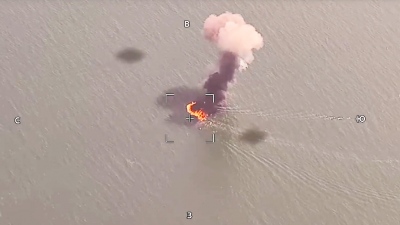
In the attacks, unmanned surface vessels, UAVs, ATACMS and Storm Shadow long-range missiles, as well as swarms of assault drones, are used simultaneously, targeting military as well as critical infrastructure.
The goal is clear: since Ukraine cannot recapture Crimea militarily, it seeks to make its retention under Russian control as costly and problematic as possible.
Strikes on energy, ports, and tourism
In Sevastopol, shipyards, port facilities, and energy infrastructure have repeatedly come under attack.
Power outages have now become a frequent phenomenon, while fuel shortages are also recorded.
At the same time, continuous alerts for missile and drone attacks have seriously affected tourism activity, with the result that the 2026 tourist season has essentially been lost.
Particular problems are also faced by transport.
The Crimean bridge as well as the road axes through the Sea of Azov are constantly targeted by Ukrainian strikes, a fact that significantly hampers the transportation of goods.
The beaches of western and southern Crimea remain almost empty, while hotel businesses and private individuals who made a living from tourism record large financial losses.
The energy grid of the Azov region targeted
The attacks by long-range Ukrainian drones are now directed mainly against energy facilities in the regions controlled by Russia.
The UAVs utilize artificial intelligence technologies and machine vision systems, while exploiting gaps in the air defense over the shallow maritime area of the Azov.
During the attacks of July, power substations and electricity transmission facilities suffered serious damage in the areas of Melitopol, Berdyansk, and Henichesk.
Power outages are now daily, with many residential areas receiving electricity for only four to six hours a day.
Rationed water and economic suffocation
The situation is worsened by high temperatures, which significantly increase the demand for electricity.
The continuous outages lead to the immobilization of pumping stations, leaving thousands of residents of apartment buildings without drinking water for long periods of time.
Hospital and social infrastructure function thanks to generators, which, however, face problems due to a lack of diesel.
At the same time, small and medium-sized enterprises suffer serious damage, as voltage fluctuations and continuous outages stop production in bakeries, dairy factories, and poultry farms.
Corresponding problems are faced by the ports of Mariupol and Berdyansk, where many businesses have limited their operations, while the increased running cost of generators renders several activities economically unprofitable.
The chronic water supply problem in Donbass
The situation appears even more difficult in the Donbass, where the chronic water supply crisis is added to the energy difficulties.
Following the interruption of supply from the Seversky Donets system in 2022, cities like Donetsk, Makeyevka, and Yasinovataya face serious water shortages.
The Russian side had presented the Don–Donbass pipeline, constructed from the Rostov region, as a solution.
However, according to the presented data, the project did not yield the expected results.
Complaints about shoddy construction in the project
According to the same information, investigations revealed that low-quality pipes were used during the construction of the pipeline, while significant economies were made in the technical preparation of the project.
The welds are characterized as problematic, with the result that the pipeline operates at approximately half of its projected capacity.
Frequent breakdowns and large leaks lead to huge quantities of water being lost into the ground, instead of reaching consumers.
At the same time, the increased extraction of water from the Don river creates, according to the same estimates, additional environmental problems in the Russian region of Rostov as well.
What Kyiv is planning
The Ukrainian attacks in the regions under Russian control demonstrate that Kyiv is no longer investing in a future diplomatic settlement, but is pursuing the systematic attrition of infrastructure.
The strategy of gradual advance, with the expectation of a future political agreement, no longer corresponds to the conditions of the war, as Ukraine continues to strike critical energy, transport, and industrial facilities in territories it no longer considers will be reintegrated under its control.
www.bankingnews.gr












Σχόλια αναγνωστών